
 The Jacobite
The greatest railway journey in the world begins with a whistle.
Fort William to Mallaig and back. Eighty-four miles of loch, mountain and sea, at the head of a working steam locomotive.
The 2026 season at a glance
- Route
- Fort William to Mallaig return, 84 miles
- Morning service
- Mon 1 June to Fri 23 October 2026, 7 days a week
- Afternoon service
- Wed 10th June to Fri 25th September 2026, 7 days per week
- Classes
- Standard and First Class, both on sale now
- Carriages
- Mk2 heritage carriages
The journey
There is a stretch of the West Highland Line, beyond Fort William, where the roads thin out and the country takes over. This is where The Jacobite runs.
She leaves in the morning, in the shadow of Ben Nevis, the highest mountain in Britain. Ahead lie eighty-four miles that keep a remarkable tally of extremes: the deepest freshwater loch in the land, Loch Morar; the shortest river, the Morar, which runs barely a quarter of a mile to the sea; the most westerly mainland railway station in Britain, at Arisaig; and, at the end of the line, Loch Nevis, the deepest sea loch in Europe.
No railway in the world keeps company like this. Wanderlust Magazine put it simply, and voted this the greatest railway journey on Earth.
Glenfinnan
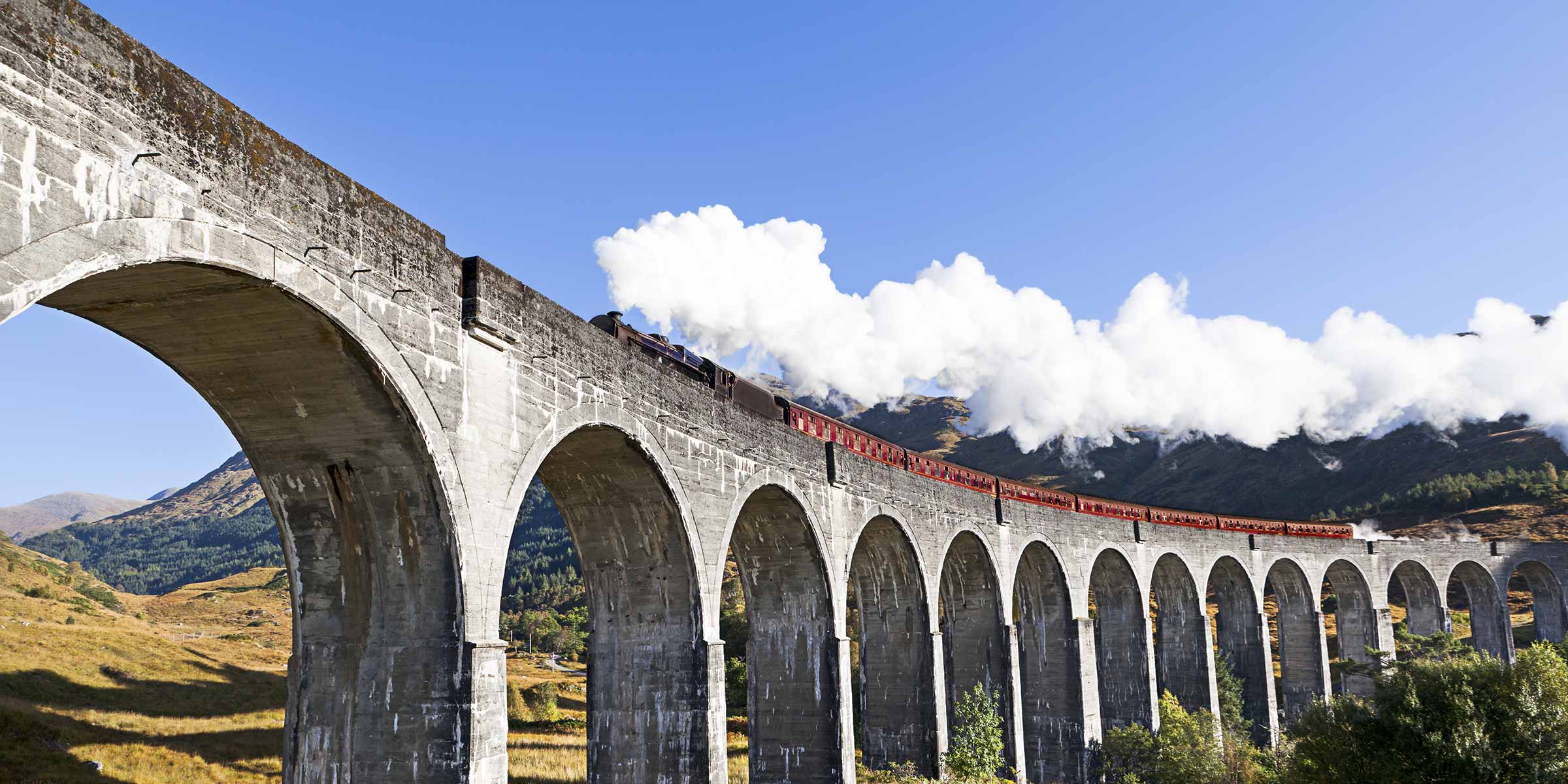
A little out of Fort William, the line sweeps onto the Glenfinnan Viaduct: twenty-one arches curving a hundred feet above the River Finnan, with Loch Shiel stretching away below. Time permitting, the train slows on the crossing, and for a moment you are held above one of the most photographed views in Scotland, a span recognised the world over from the silver screen.
This is also where the train earns its name. On the shore below stands the Glenfinnan Monument, raised in 1815 on the spot where, on 19 August 1745, Bonnie Prince Charlie raised his standard and began the last Jacobite rising. The view from the carriage window takes in both monuments at once, one to a rebellion, one to the engineers.
If the timetable allows, there is a pause at Glenfinnan station, long enough to stretch your legs and look in at the West Highland Railway Museum in the restored station building.
The line they said could not be built
When the Victorians surveyed this coast, one writer weighed the bogs, the rock and the gradients and concluded that any line would have to be carried regardless: "to go over it, or to go under it, or to go round it, or to go through it; but go they must."
Go they did. The Mallaig extension opened on 1 April 1901, driven through the schist by Sir Robert McAlpine, known ever after as Concrete Bob for the material he trusted when the rock defeated conventional masonry. His Glenfinnan Viaduct was an engineering first, and it stands today exactly as he poured it, a Category A listed structure that has carried every train on this line for a century and a quarter.
Steam worked this road for its first sixty-six years, and returned in 1984. West Coast Railways has carried the tradition since 1995, under a name that belongs to this glen: The Jacobite.
The engine
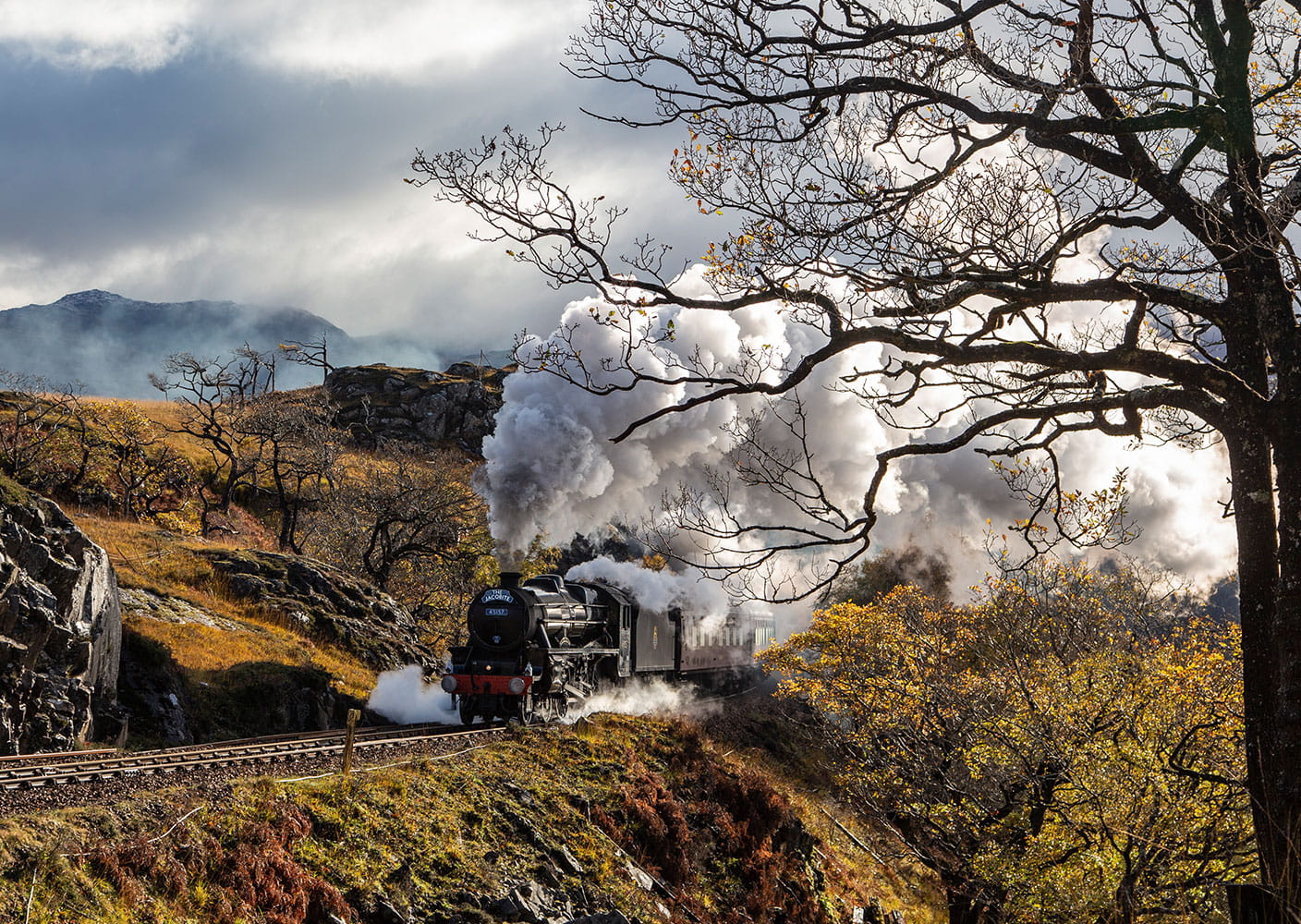
At the front, a Black Five. William Stanier's locomotive, first steamed in 1934, of which the railways built eight hundred and forty-two. One of ours, number 45407, The Lancashire Fusilier, has taken charge of The Jacobite for many years. There is no mistaking one of these engines at work on a Highland gradient: the bark of the exhaust, the smell of coal and warm oil, the long note of the whistle carrying out across the water.
To the coast
Beyond Glenfinnan the line threads the villages of Lochailort, Arisaig and Morar, and the land gives way to the sea. On a clear day, from the carriage windows, the Small Isles lie out across the water: Rum, Eigg, Muck and Canna, with the southern tip of Skye beyond. The white sands and turquoise shallows along this coast are the ones you may know from Local Hero and Highlander.
Mallaig
And then Mallaig, the end of the line. A working fishing port, where the boats still land their catch and the ferries leave for Skye, for the Small Isles, and for the roadless wilds of Knoydart. There is an hour and a half here. Time enough for the harbour, for a walk, for fish and chips eaten looking out to sea, before the locomotive runs round and turns for home.
Before you travel
A few things worth knowing:
- In periods of extreme heat, we may need to suspend the service for the comfort and safety of our passengers.
- At times of high fire risk, or in the rare event of a locomotive issue, the train may be hauled by one of our heritage diesel locomotives rather than steam.
- The guard may hold a small number of seats for sale on the day at Fort William Station. These are cash only, strictly first come, first served, and can never be guaranteed, so please book ahead.
Our reservations team is happy to help at enquiries@westcoastrailways.net.
The morning train runs every day this season, and every seat looks out on the scenery. There are not many seats. We would book early, if we were you.
Book your journey on The Jacobite